

Stopping Trazodone (Desyrel) Cold Turkey: What Happens
Stopping trazodone cold turkey usually brings on withdrawal symptoms within 1 to 3 days, led by rebound insomnia, anxiety, vivid dreams, dizziness, and nausea. For most people the worst of it lasts 1 to 2 weeks, but people who took trazodone nightly for a year or more can feel it for longer. If you already stopped and feel unwell, going back to your last dose and then tapering by about 10% of the current dose at a time is the approach most deprescribing clinicians use. The trazodone drug profile has the dose forms and basics, and the sections below cover what happens day by day, why a "sleep pill" causes withdrawal, and what to do next.
Trazodone withdrawal symptoms after stopping cold turkey, day by day
Trazodone withdrawal symptoms after an abrupt stop start fast because the drug leaves the body fast. Trazodone (Desyrel) has a short half-life measured in hours, so by the second night most of it is gone. The brain has adapted to its nightly presence, and that adaptation is suddenly unopposed.
The FDA lists these reactions directly. The Desyrel prescribing label from the FDA names nausea, sweating, irritability, agitation, dizziness, electric shock sensations, anxiety, headache, insomnia, and tinnitus as reactions "particularly after abrupt discontinuation," and it recommends a gradual dose reduction instead.
| Time after the last dose | Most common trazodone withdrawal symptoms | What it usually feels like |
|---|---|---|
| Night 1 to 2 | Rebound insomnia, restlessness | Lying awake until 3am, light and broken sleep |
| Day 2 to 4 | Anxiety, irritability, vivid dreams, nausea | A wired, on-edge feeling, stomach upset, intense nightmares |
| Day 3 to 7 | Dizziness, headache, sweating, brain zaps | Lightheaded when standing, short electric jolts on eye movement |
| Week 2 | Low mood, emotional swings, poor sleep | Physical symptoms fading, sleep and mood still unsettled |
| Week 3 and beyond | Lingering insomnia or anxiety in some people | Usually seen after long-term nightly use or high doses |
Not everyone gets every symptom. People on 25 to 50 mg for a few weeks often notice only a few rough nights. People who took trazodone nightly for years, or at antidepressant doses, tend to have a stronger and longer reaction.
Bottom line: trazodone withdrawal symptoms start within 1 to 3 days of stopping cold turkey, and rebound insomnia is almost always the first one.
From the TaperCommunity forumsPeer support
People tapering asked, and got answers
Members sharing their own experience, not medical advice. Change doses only with your prescriber.
Why stopping trazodone (Desyrel) suddenly hits harder than people expect
Stopping trazodone suddenly catches people off guard because it is usually prescribed as a harmless sleep aid. Trazodone is an antidepressant. At low doses it mostly blocks histamine and serotonin 5-HT2A receptors, which makes you drowsy. At higher doses it also blocks serotonin reuptake, the same action as Zoloft and other SSRIs.
Neuroadaptation is the brain's process of adjusting its own receptors and chemistry to a drug that is taken every day. After months of nightly trazodone, the brain has turned some systems up and others down to balance the drug. Stopping cold turkey removes the drug in a day, but the brain needs weeks to undo those changes. That gap is what withdrawal is.
Trazodone withdrawal has been documented for decades. A 1988 case report in the Journal of Clinical Psychopharmacology described cholinergic rebound after trazodone withdrawal, with symptoms like sweating, nausea, and gut upset. A 1987 report in the Journal of Clinical Psychiatry described formication, a crawling sensation on the skin, after trazodone withdrawal.
Withdrawal from antidepressants in general is common. A 2019 systematic review in Addictive Behaviors by Davies and Read found a weighted average of 56% of people experience antidepressant withdrawal effects. The same review found that withdrawal often lasts longer than the 1 to 2 weeks guidelines used to claim.
Bottom line: trazodone is an antidepressant even at sleep doses, and the brain's adaptation to it is why stopping cold turkey causes withdrawal.
"I stopped my 50 mg of trazodone three days ago and I can't sleep. What should I do?"
If you stopped trazodone 50 mg three days ago and cannot sleep, you have two reasonable options. The first is to ride it out, which works for some people on low doses and short courses. The second is to go back to your last dose, let your sleep settle, and then come down slowly. If the symptoms are making it hard to function, the second option is usually the better one.
Going back to the last dose is called reinstatement. The UK NICE guideline NG215 on medicines associated with dependence or withdrawal tells prescribers to discuss restarting the medicine at the last dose when withdrawal symptoms are severe, then tapering more slowly. Reinstatement works best when it happens early, within days to a few weeks of stopping.
The usual reinstatement sequence is short:
- Restart the last dose you were taking before you stopped.
- Wait until sleep and mood are stable, usually 1 to 2 weeks.
- Begin a slow taper, cutting a small percentage of the current dose at each step.
- Hold each step until you feel steady before making the next cut.
Symptoms often ease within a few days of reinstating. If they do not, or if they get worse, that is a reason to talk with a prescriber rather than keep adjusting on your own. The deprescriber directory lists clinicians who support slow tapers.
Bottom line: if trazodone withdrawal is severe a few days after stopping, restarting the last dose and then tapering slowly is the standard fix.
Is it safe to stop trazodone cold turkey? Comparing the 3 ways to come off
Stopping trazodone cold turkey is rarely dangerous, but it is often unpleasant, and it is the method most likely to fail. People who stop abruptly and sleep badly for a week often restart trazodone and conclude they "can't sleep without it," when the real problem was the speed of stopping.
| Approach | What it involves | Main downside | Best for |
|---|---|---|---|
| Cold turkey | Stopping all at once | Highest chance of rebound insomnia and withdrawal | Short courses of a few weeks at a low dose, or when a doctor stops it for a medical reason |
| Fast taper | Halving the dose for 1 to 2 weeks, then stopping | The final drop is still large and often triggers symptoms | People who tolerated past dose cuts with no trouble |
| Slow hyperbolic taper | Cutting about 10% of the current dose every 2 to 4 weeks | Takes months, needs smaller doses or a liquid near the end | Anyone who took trazodone nightly for months or years |
Hyperbolic tapering is a method of reducing a drug by a fixed percentage of the current dose, so the cuts get smaller as the dose gets lower. A 2019 review in The Lancet Psychiatry by Horowitz and Taylor showed that small final doses still have large effects at the receptor, which is why the last steps of a taper need to be the smallest.
The cold turkey option has honest upsides. It is fast, it needs no special doses, and on a short low-dose course many people get through it with a few bad nights. The slow taper has a real downside too. It takes months, and trazodone tablets do not split cleanly into small amounts, so people near the end often need a pharmacist to help with smaller doses.
Choose cold turkey only if you took trazodone for a few weeks at a low dose. Choose a slow taper if you took it nightly for months or longer, or if a past attempt to stop went badly.
Bottom line: a slow percentage-based taper is the safest way to come off trazodone after long-term use, and cold turkey is only reasonable after short courses.
How to taper off trazodone after a failed cold turkey attempt
Tapering off trazodone after a failed cold turkey attempt starts from a stable dose, not from wherever you landed. The goal is to make each cut small enough that your brain can adjust without your sleep falling apart.
The working principle is to reduce by about 10% of your current dose, not your starting dose, every 2 to 4 weeks. Some people need smaller cuts of 5% toward the end, and some need longer holds. The Canadian Deprescribing Network's resources at deprescribing.org use the same core idea: slow, stepwise reductions with a check-in after each one.
The taper planner shows how percentage cuts shrink as the dose falls, which makes it easier to see why the last few steps take the longest. Pair it with the taper journal to log your sleep, mood, and symptoms after each cut, so you can tell a bad night from a real trend. The tapering plan worksheet is a printable version for people who prefer paper.
If you also take another sedating medication, such as Seroquel or mirtazapine, taper one drug at a time. Changing two at once makes it impossible to know which change caused which symptom.
The full schedule-focused guide, including how to manage the last small doses, is in trazodone withdrawal symptoms and how to taper off 50 mg.
Bottom line: after a failed cold turkey stop, restabilize first, then cut about 10% of the current trazodone dose every 2 to 4 weeks.
Trazodone rebound insomnia versus the insomnia you started with
Trazodone rebound insomnia is usually worse than the sleep problem you had before you started. That is one of the clearest signs it is withdrawal and not your original insomnia returning. Rebound insomnia tends to start within 1 to 3 nights, arrives with other symptoms like anxiety or vivid dreams, and fades over 1 to 3 weeks.
Your original insomnia, by contrast, usually returns gradually, looks like the pattern you had before, and comes without dizziness, nausea, or brain zaps. If sleep improves steadily week by week after stopping, that points to withdrawal fading. If it settles into a familiar pattern months later, that points to the underlying sleep problem.
The evidence for trazodone as a long-term sleep drug is thin. A 2018 Cochrane review by Everitt and colleagues on antidepressants for insomnia found only a small short-term improvement with trazodone and no evidence for long-term use. The American Academy of Sleep Medicine's 2017 guideline on insomnia medications suggests clinicians not use trazodone for chronic insomnia at all.
That matters for people tapering. Many were put on trazodone for sleep years ago and never reassessed. Cognitive behavioral therapy for insomnia (CBT-I) is the first-line treatment in most sleep guidelines, and starting it before or during a trazodone taper gives you a sleep skill that does not depend on a pill.
Bottom line: rebound insomnia after stopping trazodone is usually worse, earlier, and shorter-lived than the original insomnia, and it fades as withdrawal resolves.
"My doctor says trazodone isn't addictive, so why do I feel so bad?"
Trazodone is not addictive in the sense of craving or escalating doses, and your doctor is right about that. Withdrawal is a different thing. Physical dependence is the body's adaptation to a drug, which causes symptoms when the drug stops, and it happens with many medications that are not addictive at all, including blood pressure drugs and steroids.
Many patients are told withdrawal from trazodone is impossible, or that their symptoms mean depression or insomnia is coming back. The FDA label says otherwise, as do the case reports. People who have been through it describe the same pattern on peer support sites like the Inner Compass Initiative's Withdrawal Project and in the experiences collected by Mad in America.
You are not imagining it, and you are not weak. You stopped a drug your brain had adapted to, and the adaptation takes time to reverse. Talking with others who have tapered trazodone in the taper.community forums can help you calibrate what is normal.
Bottom line: trazodone causes physical dependence without addiction, and feeling unwell after stopping it is a recognized withdrawal reaction.
From the Trazodone forumPeer support
Questions from people tapering Trazodone
Read more in the Trazodone forum →Members sharing their own experience, not medical advice.
Frequently asked questions
Can you stop trazodone cold turkey?
You can, and it is rarely dangerous, but it often causes rebound insomnia, anxiety, dizziness, and nausea within 1 to 3 days. The FDA label for trazodone recommends a gradual dose reduction instead of abrupt stopping whenever possible. Stopping cold turkey is most reasonable after a short course of a few weeks at a low dose.
What happens if you stop taking trazodone suddenly?
Most people sleep badly for the first few nights, then may feel anxious, irritable, dizzy, or nauseous over the following week. Some people get vivid dreams, sweating, or brain zaps. The physical symptoms usually fade within 1 to 2 weeks, while sleep and mood can take longer to settle.
How long does trazodone withdrawal last after stopping cold turkey?
For most people the worst trazodone withdrawal symptoms last 1 to 2 weeks after stopping cold turkey. People who took trazodone nightly for years, or at higher antidepressant doses, can have symptoms for several weeks. A systematic review by Davies and Read in 2019 found that antidepressant withdrawal often lasts longer than guidelines suggest.
Can I stop trazodone 50 mg cold turkey?
Many people on 50 mg for a short time stop without much trouble, but people who took 50 mg nightly for months often get rebound insomnia and anxiety. If you have been on Desyrel for more than a few months, a slow taper of about 10% of your current dose every 2 to 4 weeks is gentler. The trazodone drug profile covers the available tablet strengths.
I stopped Desyrel 2 weeks ago and still feel awful. Is it too late to go back on it?
Two weeks is usually not too late to reinstate trazodone. Reinstatement works best within days to a few weeks of stopping, and symptoms often ease within a few days of restarting the last dose. Speak with your prescriber about restarting, then plan a slow taper once you feel stable.
Coming off trazodone without the crash
Stopping trazodone cold turkey works for some people on short, low-dose courses, but long-term users usually do better with a slow, percentage-based taper. If you already stopped and feel unwell, reinstating your last dose and tapering slowly is a recognized and reasonable step, not a failure. The trazodone (Desyrel) drug profile is a good place to start planning.
taper.community is a free peer community and resource library for people coming off psychiatric drugs, built around slow, hyperbolic dose reductions. If you want to talk with people who have tapered trazodone themselves, join the conversation in the taper.community forums.
This article is for educational purposes only and is not medical advice. Do not change or stop any medication without talking to a qualified healthcare provider. If you have thoughts of suicide or self-harm, contact emergency services or a crisis line right away.
Related articles
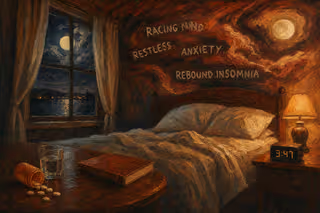
How to Sleep After Stopping Trazodone (Desyrel): Rebound Insomnia
Most people can sleep again after stopping trazodone, but the first 1 to 2 weeks are often the hardest. Rebound insomnia after stopping trazodone usually starts within 1 to 3 days, peaks in the first week or two, and eases over several weeks as the brain readj

Trazodone Withdrawal Symptoms & How to Taper Off 50 mg
Trazodone withdrawal is real, even at the low 25 to 100 mg doses prescribed off-label for sleep. Trazodone withdrawal symptoms usually start 24 to 72 hours after a cut, peak around days 3 to 7, and ease over 2 to 4 weeks, with rebound insomnia, anxiety, dizziness, and nausea the

Imipramine (Tofranil) Withdrawal Symptoms & Taper Schedule
Imipramine withdrawal usually begins within 1 to 3 days of a dose reduction and can last anywhere from 2 weeks to several months, depending on how long you took imipramine and how quickly you came off it. The most common symptoms are nausea, stomach cramping,

Ambien (Zolpidem) Withdrawal: Rebound Insomnia and How to Taper
Zolpidem, sold under the brand name Ambien, is a "Z-drug" sedative-hypnotic prescribed for short-term insomnia. It is not a benzodiazepine, but it acts on the same GABA-A receptors, and stopping it abruptly after regular use for more than a few weeks can trigger

Seroquel (Quetiapine) Taper Schedule: 25 mg to 300 mg
A workable Seroquel taper schedule reduces by 10% or less of your current dose each month, not 10% of where you started, and holds at each step until you feel steady again. That means the cuts get smaller in absolute terms every single time, and the last stretch near zero takes t

Stopping Cymbalta (duloxetine) Suddenly: What Happens and What to Do
Stopping duloxetine cold turkey causes withdrawal symptoms in roughly 44% of people within the first few days, compared with 23% on placebo, according to a pooled analysis of Eli Lilly's own trials. Cymbalta has a short half-life of about 12 hours, so blood lev

Abilify (Aripiprazole) Withdrawal Symptoms & Taper Schedule
Abilify withdrawal symptoms usually start 2 to 7 days after a dose cut. The most common are insomnia, nausea, anxiety, irritability and a restless, can't-sit-still feeling. With a slow taper each wave tends to last 1 to 2 weeks, while stopping cold turkey can bring weeks to month

How to Taper Off Prozac (Fluoxetine): Why the Long Half-Life Changes Everything
Most people can taper off Prozac (fluoxetine) by reducing 10% of their current dose every 4 weeks, then slowing down further below 5 mg. Fluoxetine has the longest half-life of any SSRI, roughly 4 to 6 days for the parent drug and up to 16 days for its active met
No comments yet. Be the first to ask about this.
Join the discussion
Already a member? Sign in