
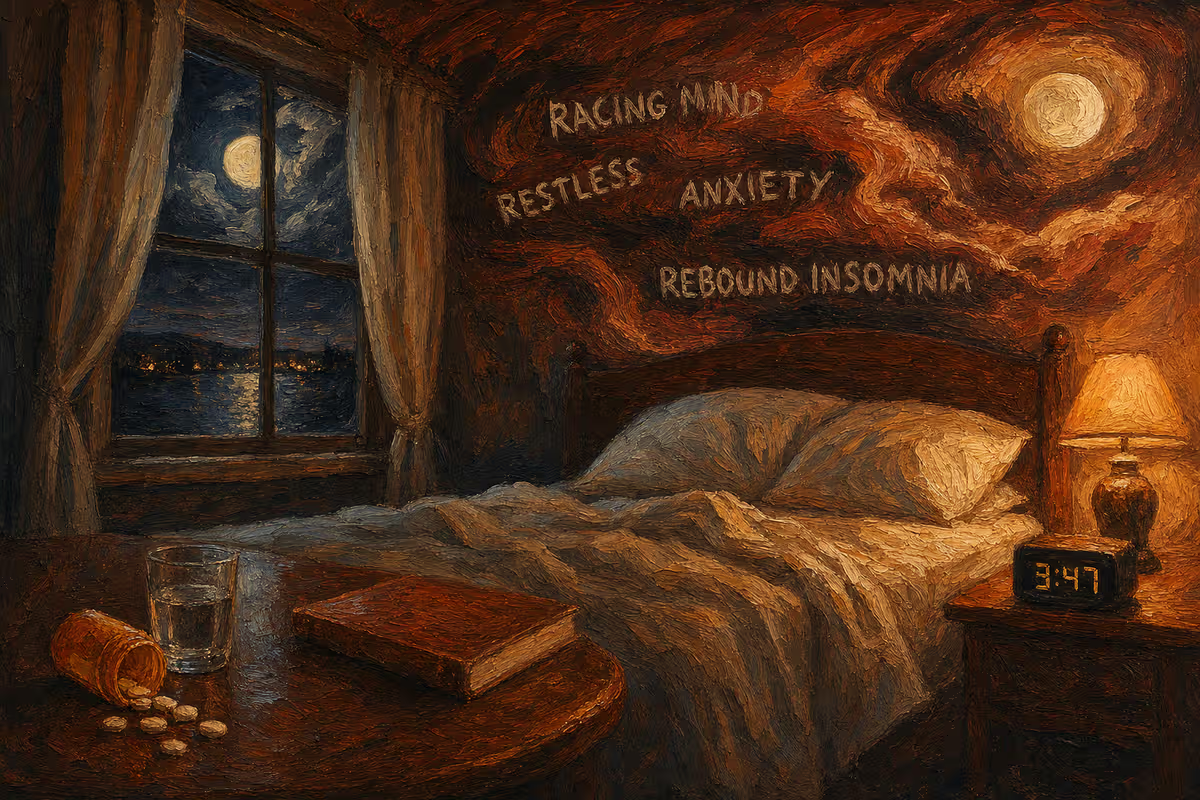
How to Sleep After Stopping Trazodone (Desyrel): Rebound Insomnia
Most people can sleep again after stopping trazodone, but the first 1 to 2 weeks are often the hardest. Rebound insomnia after stopping trazodone usually starts within 1 to 3 days, peaks in the first week or two, and eases over several weeks as the brain readjusts. The two things that help most are a slow, proportional taper instead of a sudden stop, and cognitive behavioral therapy for insomnia (CBT-I), which major guidelines rank above any sleep medication.
Trazodone (brand name Desyrel) is an antidepressant that is prescribed far more often for sleep than for depression, usually at 25 mg to 100 mg at night. That makes the question of how to sleep after stopping trazodone a practical one for millions of people. This guide covers what the rebound looks like, why it happens, and what actually restores sleep.
Rebound insomnia after stopping trazodone: what to expect week by week
Rebound insomnia after stopping trazodone is usually worst in the first 1 to 2 weeks and fades over the following month for most people. Trazodone has a short half-life of roughly 5 to 9 hours according to the FDA prescribing information for Desyrel (trazodone), so its sedating effect is gone within a day or two of the last dose. That is why sleep trouble shows up fast.
The table below is a typical pattern, built from the drug's pharmacology and from what people tapering in our community consistently report. It is not a guarantee. People who stop abruptly after years of nightly use tend to sit at the longer end.
| Time since last dose | What sleep often looks like | Other common symptoms |
|---|---|---|
| Nights 1 to 3 | Trouble falling asleep, light sleep, early waking | Restlessness, anxiety at bedtime |
| Week 1 to 2 | Peak rebound insomnia, broken sleep, vivid dreams | Irritability, nausea, dizziness, low mood |
| Weeks 3 to 4 | Sleep onset slowly improves, nights become uneven | Tiredness during the day, fading anxiety |
| Months 1 to 3 | Most people near their pre-trazodone baseline | Occasional bad nights, often stress-linked |
Sleep after trazodone rarely improves in a straight line. A good night followed by two bad ones is normal and does not mean the process has stalled. Tracking sleep in a symptom journal makes the trend visible when single nights feel discouraging.
Withdrawal from antidepressants lasts longer than older guidance suggested. A systematic review by Davies and Read (2019) in Addictive Behaviors found that 56% of people who stopped antidepressants experienced withdrawal effects, and many reported them lasting weeks or months.
Bottom line: expect the hardest nights in the first 2 weeks after stopping trazodone, and judge progress by the weekly trend, not by any single night.
From the TaperCommunity forumsPeer support
People tapering asked, and got answers
Members sharing their own experience, not medical advice. Change doses only with your prescriber.
Why sleep gets worse after stopping trazodone
Sleep gets worse after stopping trazodone because the brain adapted to having the drug's sedation every night, and it takes time to readjust when that sedation disappears. At low doses, trazodone blocks histamine H1 receptors, serotonin 5-HT2A receptors, and alpha-1 adrenergic receptors. All three effects push the brain toward sleep.
After months or years of nightly use, the nervous system compensates for that steady push. When trazodone is removed, the compensation remains for a while with nothing to balance it. The result is a brain tilted toward wakefulness.
Rebound insomnia is insomnia that returns worse than it was before treatment, for a limited period, after a sleep medication is stopped. It differs from relapse, which is the original insomnia coming back at its old level and staying. Rebound is temporary by definition, even though it rarely feels that way at 3am.
A second factor is conditioning. Many people have paired "take the pill" with "now I can sleep" for years. Without the pill, bedtime itself can trigger alertness and worry, which is the same pattern that drives chronic insomnia. This is why behavioral treatment matters as much as the taper.
Trazodone also appears on the list of medicines covered by the NICE guideline NG222 on medicines associated with dependence or withdrawal symptoms, which tells prescribers to plan gradual reductions with the patient instead of stopping abruptly. The detailed symptom picture for this drug is covered in the trazodone withdrawal and taper guide.
Bottom line: trazodone rebound insomnia comes from a brain that adapted to nightly sedation, plus a learned link between the pill and sleep, and both recover with time and the right approach.
How a slow trazodone taper protects your sleep
A slow taper protects your sleep by giving the brain time to adjust in small steps, so rebound insomnia stays mild instead of arriving all at once. Stopping trazodone suddenly removes all of its sedation overnight. Tapering removes it in pieces the nervous system can absorb.
The method with the strongest scientific rationale is hyperbolic tapering, which means reducing by a percentage of the current dose rather than a fixed amount, so each cut gets smaller as the dose gets lower. A widely cited 2019 Lancet Psychiatry paper by Horowitz and Taylor showed that the effect of these drugs on their brain targets changes most at low doses. That explains why the last stretch of a taper so often hurts the most.
| Approach to stopping trazodone | Effect on sleep | Best for |
|---|---|---|
| Abrupt stop | Full rebound within days, often severe | Only when a prescriber requires it for safety |
| Fast fixed-amount taper over 1 to 2 weeks | Smaller rebound, but large cuts near the end | Short-term users of a few weeks |
| Slow proportional taper, about 10% of current dose | Mild, manageable sleep disruption at each step | Long-term nightly users |
A common starting point is a cut of around 10% of the current dose, held until sleep settles for 2 to 4 weeks before the next step. Some people need smaller cuts at the bottom. The exact pace is personal, and sleep quality is a good guide to whether a step was too big.
The taper planner visualizes how proportional reductions shrink as the dose falls, and the tapering plan worksheet helps you write the plan down with your prescriber. Low trazodone doses can be hard to cut evenly from tablets, so ask a pharmacist about formulation options.
Bottom line: a slow, proportional trazodone taper with holds between steps is the single best way to protect sleep while coming off.
CBT-I: the most effective way to sleep without trazodone
Cognitive behavioral therapy for insomnia (CBT-I) is a structured, short-term treatment that retrains the sleep system using sleep scheduling, stimulus control, and changes to unhelpful thoughts about sleep. CBT-I is the most effective long-term way to sleep without trazodone, and the evidence behind it is stronger than the evidence for trazodone itself.
The American College of Physicians guideline (Qaseem et al., 2016) strongly recommends CBT-I as the first treatment for chronic insomnia in adults. The American Academy of Sleep Medicine guideline (Sateia et al., 2017) went further on trazodone, suggesting that clinicians not use it to treat sleep onset or sleep maintenance insomnia.
The research case for trazodone as a sleep drug is thin. A Cochrane review of antidepressants for insomnia (Everitt et al., 2018) found only low-quality evidence for low-dose antidepressants, including trazodone, and few long-term studies. Many people are relieved to learn that sleeping without trazodone does not mean giving up a proven treatment.
CBT-I works best when started before or during the taper, not after the rebound hits. It is available from trained therapists, through some sleep clinics, and in self-guided programs and apps. A typical course runs 4 to 8 weeks.
The core of CBT-I is sleep restriction, which means limiting time in bed to roughly the hours you actually sleep, then widening that window as sleep consolidates. It feels counterintuitive and makes you tired in the first week. That tiredness builds the sleep pressure that eventually replaces the drug.
Bottom line: CBT-I is the first-line insomnia treatment in major guidelines, and starting it alongside a trazodone taper gives the brain a non-drug path back to sleep.
A trazodone-free night routine for the first month
A steady, simple routine helps sleep recover faster after stopping trazodone because a regular schedule strengthens the body clock while the brain readjusts. The goal is not a perfect routine. The goal is fewer things fighting your recovery.
These five habits do the most work during the first month off trazodone:
- Get up at the same time every morning, including weekends, even after a bad night.
- Go to bed only when sleepy, not at a fixed early hour to "catch up."
- Leave the bed if you are awake for what feels like 20 minutes, and return when drowsy.
- Get outdoor light within an hour of waking to anchor the body clock.
- Cut caffeine after midday and avoid alcohol, which fragments sleep in the second half of the night.
Avoid long daytime naps during this period. A nap drains the sleep pressure you need at night. If you must nap, keep it under 30 minutes and before mid-afternoon.
Be cautious about replacing trazodone with another sleep medication. Sleeping pills such as Ambien (zolpidem) carry their own dependence and withdrawal problems, and the deprescribing guidance at deprescribing.org recommends behavioral sleep approaches for people coming off sleep medicines. Starting a new drug to cover trazodone rebound insomnia tends to postpone the recovery rather than shorten it. People sleeping through benzodiazepine withdrawal use many of the same strategies, covered in the guide on sleeping during benzo withdrawal.
Bottom line: a fixed wake time, getting out of bed when awake, and morning light rebuild natural sleep after trazodone faster than any supplement.
"I stopped trazodone two weeks ago and I've barely slept. Should I go back on it?"
If you stopped trazodone recently and sleep loss is severe or getting worse, going back to the last dose that worked and then tapering more slowly is a reasonable option to discuss with your prescriber. This is called reinstatement. It works best when done soon after stopping, usually within a few weeks.
Reinstatement is not failure. It is a way to stabilize and then come off at a pace your brain can handle. Many people who stopped trazodone cold turkey succeed on a second, slower attempt. The risks of stopping abruptly are covered in the guide on stopping trazodone suddenly.
Some situations call for prompt medical help rather than waiting it out. These include going several nights with almost no sleep, thoughts of self-harm, severe agitation, or a return of depression that trazodone was originally treating. Severe sleep deprivation affects mood, judgment, and driving safety.
If your prescriber is unfamiliar with gradual tapering, the deprescriber directory lists clinicians who support slow, proportional reductions. Bring your sleep log to the appointment. A record of nights and symptoms gets taken more seriously than a general complaint.
If you decide to keep going without reinstating, pairing CBT-I techniques with patience is the evidence-based path. Peer members of Surviving Antidepressants and our own forums have documented many trazodone tapers, including the uneven nights that come with them.
Bottom line: severe or worsening insomnia two weeks after stopping trazodone is a reason to talk to a prescriber about reinstating and tapering slowly, not something you have to endure alone.
How to tell trazodone rebound insomnia from your original insomnia
Trazodone rebound insomnia usually starts within days of a dose cut and improves over weeks, while your original insomnia tends to return more gradually and hold steady. Timing is the most useful clue. A sharp change 1 to 3 days after a reduction points to withdrawal.
Rebound insomnia also tends to arrive with other withdrawal symptoms. Irritability, dizziness, nausea, vivid dreams, and a wired-but-tired feeling suggest the nervous system is readjusting. Original insomnia usually comes without those physical signs.
The trend over 4 to 6 weeks settles the question for most people. Withdrawal-driven insomnia improves with time even when it fluctuates. Original insomnia does not improve on its own, which is the signal to put CBT-I at the center of the plan.
Bottom line: insomnia that appears quickly after a trazodone cut and comes with physical symptoms is most likely rebound, and it improves with time.
Private check-in
How are you feeling today?
Frequently asked questions
How long does insomnia last after stopping trazodone?
Insomnia after stopping trazodone most often peaks in the first 1 to 2 weeks and improves over 3 to 4 weeks. Some long-term users report uneven sleep for 1 to 3 months. A slower taper usually shortens and softens the rebound.
Will I ever sleep normally again without trazodone?
Yes, most people return to their pre-trazodone sleep or better. Rebound insomnia is temporary because the brain readjusts. Adding CBT-I treats any underlying insomnia that trazodone was masking.
Can I take melatonin after stopping trazodone?
Melatonin is low-risk for most adults, but its effect on chronic insomnia is small, and the American Academy of Sleep Medicine does not recommend it as a main insomnia treatment. It may help shift the body clock if your sleep timing has drifted. Ask a pharmacist about interactions with any other medicines you take.
Is it normal to have vivid dreams after stopping Desyrel?
Vivid or intense dreams are commonly reported after stopping Desyrel (trazodone), especially in the first 2 weeks. They usually fade as sleep stabilizes. Nightmares that persist past a month are worth raising with a prescriber.
I've taken trazodone 50mg every night for years. How do I stop without wrecking my sleep?
Reduce by a small percentage of your current dose, around 10%, and hold each step until sleep settles for 2 to 4 weeks. Start CBT-I before the first cut. Keep a sleep log so you can slow down if a step hits too hard.
Sleeping after trazodone: where to go from here
Sleeping after trazodone is very achievable, and rebound insomnia is the brain's temporary adjustment, not a permanent state. A slow proportional taper, CBT-I, and a fixed wake time do most of the work. The trazodone drug profile collects dosing context, withdrawal information, and related guides in one place.
taper.community is a free peer community and resource library for people coming off psychiatric medications, including sleep medicines like trazodone, at a pace their nervous system can handle. If you are in the middle of a hard stretch of nights, the forums are a good place to compare notes with people who have slept their way through the same thing.
This article is for educational purposes only and is not medical advice. Do not stop or change any medication without talking to a qualified healthcare provider. If you have thoughts of self-harm, contact emergency services or a crisis line right away.
From the Trazodone forumPeer support
Questions from people tapering Trazodone
Read more in the Trazodone forum →Members sharing their own experience, not medical advice.
Related articles

Stopping Trazodone (Desyrel) Cold Turkey: What Happens
Stopping trazodone cold turkey usually brings on withdrawal symptoms within 1 to 3 days, led by rebound insomnia, anxiety, vivid dreams, dizziness, and nausea. For most people the worst of it lasts 1 to 2 weeks, but people who took trazodone nightly for a year or more can feel it

Trazodone Withdrawal Symptoms & How to Taper Off 50 mg
Trazodone withdrawal is real, even at the low 25 to 100 mg doses prescribed off-label for sleep. Trazodone withdrawal symptoms usually start 24 to 72 hours after a cut, peak around days 3 to 7, and ease over 2 to 4 weeks, with rebound insomnia, anxiety, dizziness, and nausea the

Depersonalization During Withdrawal: Why You Feel Unreal
Depersonalization during withdrawal is one of the more frightening symptoms people encounter when tapering or stopping psychiatric medications. You look in the mirror and feel like a stranger is looking back. You watch yourself move through a room as if from a distance. The world

Visual Disturbances During Withdrawal: Floaters, Flashes, and Blurred Vision
Visual disturbances are one of the most frightening and least talked about symptoms of psychiatric drug withdrawal. People tapering off antidepressants, benzodiazepines, and other medications report floaters, flashes of light, blurred vision, light sensitivity, trailing images, a

Brain Fog and Cognitive Problems During Withdrawal: When Thinking Gets Hard
Cognitive problems during withdrawal are one of the most disorienting and underdiscussed effects of stopping psychiatric medication. People describe word-finding trouble, blank stares mid-sentence, short-term memory lapses, and a heavy mental fog that makes routine tasks feel imp

Emotional Blunting From SSRIs: When You Can't Feel Anything Anymore
Emotional blunting from SSRIs is one of the most common, and most under-discussed, side effects of long-term antidepressant use. People describe it as feeling flat, muted, or disconnected from things that used to matter to them. The technical term is SSRI-induced emotional blunti

Withdrawal Akathisia: What It Feels Like and How Long It Lasts
Withdrawal akathisia usually lasts 1 to 4 weeks once the taper is held steady, and weeks to months after an abrupt stop. It is an intense inner restlessness, a physical compulsion to keep moving, triggered when antidepressant dose drops faster than the nervous system can adapt. A

Weight Change After Stopping Olanzapine (Zyprexa): What to Expect
Most people lose some weight after stopping olanzapine, because the drug's strong push on appetite fades once it leaves the body. The loss is usually slow and partial, unfolding over roughly 3 to 12 months, and it rarely erases all the weight gained. The first 2 to 4 weeks can br
No comments yet. Be the first to ask about this.
Join the discussion
Already a member? Sign in