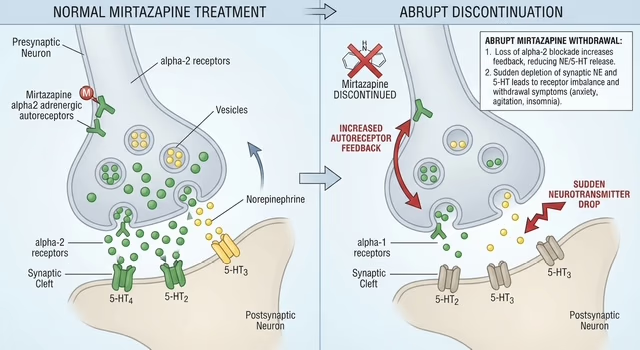
The diagram below outlines the standard structure of a chemical synapse. During antidepressant withdrawal, this delicate signaling system undergoes a rapid shift in neurotransmitter levels and receptor activity.
Step-by-Step Breakdown of Mirtazapine Withdrawal
Mirtazapine is a noradrenergic and specific serotonergic antidepressant (NaSSA). It works primarily by blocking specific "brakes" (alpha-2 autoreceptors) and specific serotonin targets (\(5\text{-HT}_2\) and \(5\text{-HT}_3\)). Stopping it too quickly destabilises this adapted environment.
1. Baseline Adaptation (While Taking Mirtazapine)
The "Brakes" are Off: Mirtazapine blocks presynaptic \(\alpha _{2}\)-adrenergic autoreceptors. These receptors normally act as a thermostat to turn down noradrenaline release. By blocking them, Mirtazapine forces the brain to release more noradrenaline and serotonin.
Receptor Downregulation: Because the synapse has been flooded with higher levels of these chemicals over time, the postsynaptic receptors adapt by decreasing in number or sensitivity (downregulation) to prevent overstimulation.
Targeted Blockade: Mirtazapine continuously blocks postsynaptic \(5\text{-HT}_2\) and \(5\text{-HT}_3\) serotonin receptors, redirecting serotonin exclusively to beneficial \(5\text{-HT}_1\) receptors.
2. The Sudden Discontinuation (The Crash)
The Brakes Slam On: When Mirtazapine is abruptly removed, the presynaptic \(\alpha _{2}\) autoreceptors are suddenly unblocked. They instantly resume their role, heavily restricting the release of noradrenaline.
Neurotransmitter Plunge: As a result, the amount of both noradrenaline and serotoninemptying into the synaptic cleft drops drastically and suddenly.
3. The Receptor Mismatch (Withdrawal State)
Starved Postsynaptic Receptors: The postsynaptic receptors—which were already downregulated (reduced) from months of medication use—are suddenly starved of neurotransmitters.
Unmasked Serotonin Receptors: The \(5\text{-HT}_2\) and \(5\text{-HT}_3\) receptors are no longer blocked by the drug. Because overall serotonin levels have plummeted, the entire serotonergic system experiences a severe deficit in signaling.
The Histamine Rebound: Mirtazapine is also a potent antihistamine. Sudden removal causes a massive rebound surge in histamine signaling, contributing heavily to insomnia, intense anxiety, and physical agitation.
4. Systemic Consequences
This sudden deficit across noradrenaline and serotonin networks causes the physical and psychological symptoms of withdrawal (such as dizziness, brain zaps, nausea, severe anxiety, and sweating) while the brain slowly struggles to re-regulate (upregulate) its receptor density back to its natural baseline.
 TaperCommunity

